
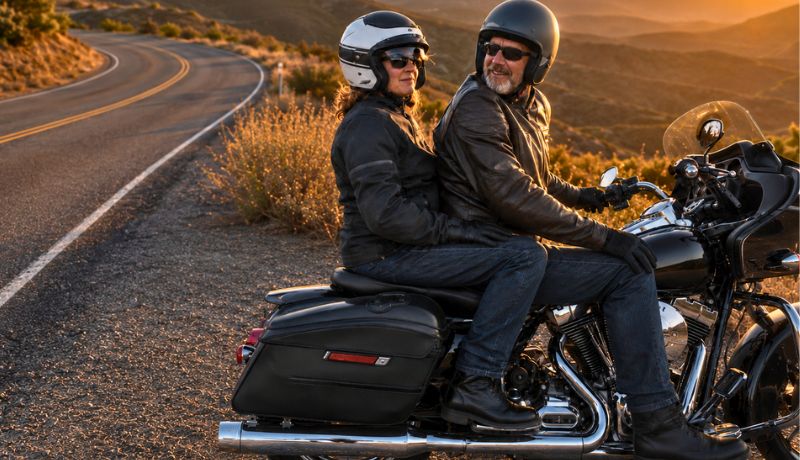
Many motorcycle passengers quietly worry about the same thing.
Not just whether they’re safe.
Not just whether they’re comfortable.
But whether they’re being a good passenger.
You might be wondering this too.
Are you helping or making things harder?
Can the rider feel that you’re tense?
Are you sitting badly, leaning wrongly, holding on too much, not holding on enough, or somehow just being dead weight on the back?
These fears are incredibly common.
Especially when you’re new, it can be easy to feel as if the rider is doing all the motorcycle work, and you’re just an extra on the back.
But being a good motorcycle passenger is not about being perfect, silent, tiny, or finding pillion riding magically effortless.
And it’s definitely not about pretending you have no needs.
A good passenger is usually someone who feels reasonably settled, moves with the bike instead of against it, communicates honestly, and makes the ride smoother by being calm, predictable, and cooperative.
That’s much more achievable than many passengers think.
In this guide, we’ll look at what actually makes someone a good motorcycle passenger, what doesn’t help, and how to stop confusing “being a burden” with simply being new.
The short answer
A good motorcycle passenger is not someone who never moves, never speaks, and never needs anything. A good passenger is usually someone who stays relaxed, works with the rider and the motorcycle rather than against them, and communicates when something matters. If you’re calm, honest about your limits, and willing to learn, you’re probably already much closer to being a great passenger than you think.
Being a good passenger doesn’t mean disappearing
This matters, because a lot of passengers unconsciously think “good” means invisible.
That they shouldn’t:
- move
- speak
- ask to stop.
- admit they’re scared, or
- say they need something different.
None of those things are helpful.
In fact, they make things much harder – for both you, and the rider.
A rider doesn’t need a passenger who’s pretending to be fine while silently panicking, freezing with discomfort, or pushing past limits they should’ve spoken up about an hour earlier.
Being a good motorcycle passenger is not about erasing yourself.
It is about becoming easier to ride with.
And that usually comes from a mix of body awareness, communication, honesty, and trust.
All of these factors work better than self-silencing.
A good passenger moves with the bike, not against it
Good passengers usually start learning how to:
- stay settled instead of flopping around
- lean naturally with the rider and the bike
- avoid sudden movements, and
- hold on in a calm, supportive way rather than a panicked one.
If the bike speeds up, slows down, or corners, you’re not trying to “correct” it from the back. You’re learning how to move with it in a way that feels smoother for both of you.
If that part still feels uncertain, how a motorcycle passenger should hold on and how motorcycle passengers should lean in corners both help build this foundation.

A good passenger is predictable
Predictability matters a lot on a motorcycle.
The rider doesn’t need you to be flawless.
But they do need you to be reasonably steady.
That means avoiding things like:
- sudden shifts in body position
- sharp movements in corners
- surprise grabs
- leaning the wrong way in panic, and
- randomly sitting up or twisting around at the wrong moment.
A passenger who’s calm and predictable helps make the whole ride feel smoother.
The motorcycle works best when rider and passenger are not sending it mixed messages.
Why communication matters before the ride starts
A lot of what makes someone a good passenger happens before the wheels even start moving.
For example:
- saying if you’re nervous
- checking how you’ll get on and off
- agreeing on simple signals
- mentioning if you need a break
- saying if something feels physically wrong, and
- being honest about your experience level.
That’s not high-maintenance.
That’s actually helpful.
A good rider would rather know what’s going on than try to guess.
And as the passenger, you never need to prove your toughness by staying silent.
If you’re still building confidence around this, how to feel more confident on a motorcycle for passengers may help too.
Comfort matters more than many passengers think
This is another place where people get the wrong idea.
Some passengers think being “good” means tolerating everything without complaint.
But if your helmet hurts, your back aches, your legs are cramping, or you feel unstable on the seat, that affects the ride.
Your comfort really matters.
That’s because comfort affects:
- how relaxed you are
- how well you move with the bike
- how long you can stay settled
- how tense your body becomes, and
- how safe and enjoyable the ride feels overall.
So yes, a good passenger does pay attention to comfort.
Not because they’re being difficult, but because physical discomfort often turns into tension, distraction, and bad body habits.
If that side of things is getting in the way, how to make a motorcycle passenger seat WAY more comfortable may help.
Calm helps more than pretending to be brave
This may be one of the most useful mindset shifts in the whole article.
A lot of passengers think they need to be “brave” by acting unfazed.
But pretend bravery is not helpful.
If you’re silently terrified, locking up your body, and trying to hide it so you seem easy-going, that doesn’t help the rider nearly as much as calm honesty would.
Genuine calm is more useful than false bravado.
And feeling steady is more useful than dramatic toughness.
A passenger who says, “I’m a bit nervous on corners, so I may need a gentler pace while I get used to it,” is often being much more helpful than someone who says nothing and stiffens through every bend.
A good passenger still has boundaries
This is important.
Being a good motorcycle passenger doesn’t mean saying yes to every ride, every speed, every weather condition, every road, or every rider mood.
In fact, having boundaries can make you a better passenger.
Because when you ride within your limits, you’re much more likely to be calm, present, and cooperative on the bike.
So if you know when to say:
- not today
- I’m too tired
- I’m not up for that road
- I need a stop, or
- I don’t feel OK riding like this
… you’re not being difficult.
You’re being honest.
And honesty is a much better riding companion than silent resentment or fear.
If that resonates, when NOT to ride on the back of a motorcycle may help too.

Learning matters more than performing
Many passengers secretly feel they should already know how to do everything well.
How to sit.
How to hold on.
How to lean.
How to stay relaxed.
How to be easy to ride with.
But how can you automatically know all this if it’s new to you?
Give yourself time to learn.
Because learning is not the same as failing.
A good motorcycle passenger is often just someone who’s paying attention, trying, and gradually becoming easier to ride with over time.
You don’t need to land on the passenger seat fully formed.
You don’t need to act like this all feels natural if it doesn’t yet.
Some of the best passengers are simply the ones who stay open, honest, and willing to learn instead of shutting down in shame.
If that early awkwardness feels familiar, what first-time motorcycle passengers are afraid to say out loud may feel very familiar too.
It shouldn’t feel like you’re dead weight
This is so important to remember.
Many passengers worry that because they’re not controlling the bike, they’re not really contributing anything.
But that’s simply not true.
You contribute by:
- being balanced
- being calm
- being predictable
- being honest
- being cooperative
- not working against the motorcycle, and
- helping the overall rhythm of the ride feel smoother.
That is not nothing.
That’s a big part of what makes pillion riding work well.
You don’t need to “do” as much as the rider to matter.
You just need to do your part well.
And your part is more significant than it may feel from the back seat.
What often makes a passenger harder to ride with
Sometimes it helps to name the things that motorcycle passengers do that can actually make a ride harder.
Usually, it is not about “being new.”
It’s more often things like:
- freezing in tension and never communicating
- making sudden unpredictable movements
- trying to lean independently in a dramatic way
- ignoring discomfort until it becomes a problem
- staying silent about fear, pain, or limits
- treating normal learning as failure, and
- pushing through when you really should have spoken up.
That list is useful because it shows something important:
Being a “difficult” passenger usually has nothing to do with how much experience you have.
It is more often about disconnection, silence, or panic.
Those are things that can improve.
What being a good motorcycle passenger often feels like
Being a good motorcycle passenger often feels like:
- less scrambling
- less self-consciousness
- less over-gripping
- less feeling of being left behind by the bike
- more trust in the rider
- more ability to breathe normally
- more ability to notice what’s happening without panicking, and
- more feeling of being part of the ride rather than a problem inside it.
It usually feels quieter than people expect.
Less like proving yourself.
And a lot more like settling in.

Practice while the bike is parked
Practicing privately on the motorcycle in the driveway is a fantastic idea.
You can improve a surprising amount before you head out on your next ride.
Sitting on the bike while parked can help you notice:
- whether you feel perched or settled
- whether your hold feels supportive or panicked
- whether your body position feels balanced
- whether communication with the rider feels easy, and
- whether something in your setup already feels off.
This kind of practice doesn’t replace on road experience, of course.
But it can reduce pressure and help your body recognise a calmer starting point before the ride begins.
What not to confuse with being “good”
It’s also worth saying clearly that being a great passenger does not mean:
Never needing a break
Everyone has limits.
Never feeling nervous
Nerves are normal.
Never speaking up
Silence is not the same as cooperation.
Never asking for comfort
Comfort affects the ride.
Never making mistakes
Most passengers learn by doing.
Never having boundaries
Boundaries often make riding better, not worse.
It gets easier as trust and experience grow
A lot of this becomes easier over time.
Not because you suddenly become the best pillion in the world.
But because ride by ride, your body settles more quickly, your communication gets easier, and the rider starts to feel less like someone you mustn’t inconvenience – and more like someone you’re enjoying riding through the sunshine with.
That shift matters.
The more trust there is, the less you tend to interpret every need, question, or adjustment as “being a problem.”
And the more experience you get, the more you realise that good passengering is usually not about impressing anyone.
It is about making the ride work well for both people.
If that part resonates, when a motorcycle passenger starts to trust the rider is a very natural next read.

Final thoughts
So, how do you be a good motorcycle passenger?
Not by trying to be invisible.
Not by pretending to be fearless.
And definitely not by acting as if needing comfort, honesty, or limits makes you a burden.
A good motorcycle passenger helps the ride feel smoother by being calm, predictable, communicative, and willing to learn.
That’s enough.
More than enough, in fact.
And if you’re still in the awkward stage where you worry you’re getting everything wrong, that doesn’t mean you’re a bad passenger.
It just means you’re still becoming a more settled one.
FAQs
What makes a good motorcycle passenger?
A good motorcycle passenger usually stays calm, predictable, and cooperative on the bike.
They move with the rider and motorcycle rather than against them, and they communicate honestly when something matters.
Do you need experience to be a good motorcycle passenger?
Not necessarily.
Experience helps, but many good passengers are simply honest, willing to learn, and reasonably aware of how their body and communication affect the ride.
Does being a good passenger mean staying silent?
No.
Good passengering is not about silence.
It is often much more helpful to communicate clearly about comfort, fear, breaks, or limits than to pretend everything is fine.
Can you be a good motorcycle passenger if you feel nervous?
Yes.
Feeling nervous doesn’t make you a bad passenger.
What matters more is how you handle those nerves and whether you communicate and work with the bike rather than against it.
What makes a passenger harder to ride with?
Usually things like sudden movements, panic, silence about discomfort, or fighting the bike.
Being new is not the same as being a difficult passenger.
Should a good motorcycle passenger have boundaries?
Yes.
Boundaries often make riding better, because they help you stay within the conditions where you can ride calmly and cooperatively.
Further reading
If you’re still finding your feet on the back of a bike, these are good next reads:
How a Motorcycle Passenger Should Hold On
If you’re not quite sure where your hands should go — or whether you’re gripping too hard, too lightly, or in the wrong place — this will help make holding on feel calmer and more natural.
How to Feel More Confident on a Motorcycle (For Passengers)
This is a good next step if the harder part feels emotional rather than practical, and you’re trying to feel safer, steadier, and less self-conscious on the bike.
When NOT to Ride on the Back of a Motorcycle
A useful read if you’re learning that being a good passenger also means knowing your limits, speaking up honestly, and not forcing yourself through rides that don’t feel right.


A lot of passengers worry that being “good” means being silent, easy, and never needing anything. It doesn’t. If that fear has been sitting quietly in the background for you, you might also like How to Feel More Confident on a Motorcycle (For Passengers) — because sometimes what feels like “being a burden” is really just being new.