
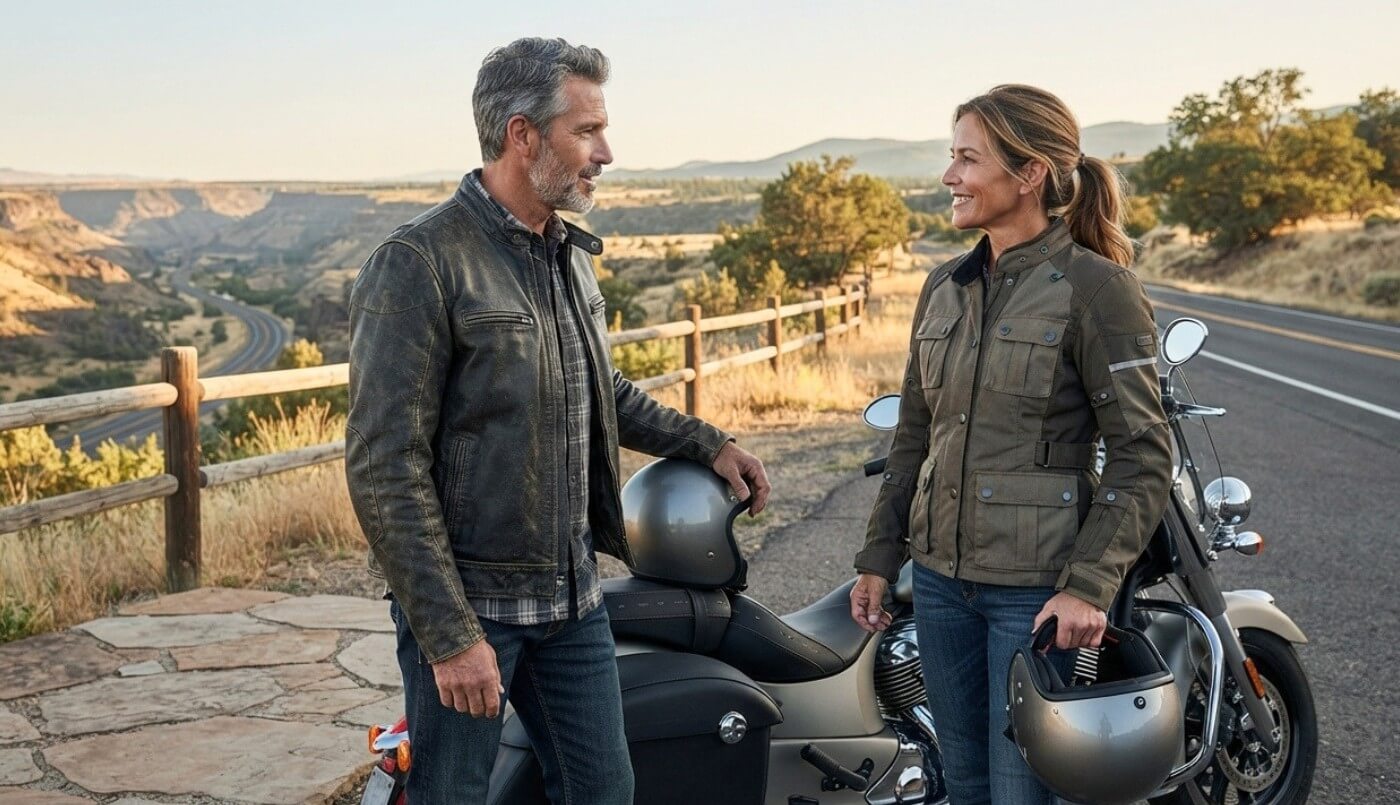
Riding a motorcycle with a passenger changes everything.
It affects how the bike handles.
There’s more weight, more responsibility and another human being whose movements you suddenly need to take into account.
But it can also be one of the best things about riding.
There’s something about disappearing down the road together that cuts through a lot of everyday nonsense.
No-one cares who cleaned the toilet when you’re roaring down the highway together.
But if you’re figuring out how to ride a motorcycle with a passenger, there’s something riders sometimes forget.
Your passenger may know almost nothing about motorcycles.
You know what happens when you accelerate.
You expect the bike to lean.
You know where the foot pegs are, what that strange mechanical noise means and why you’re suddenly slowing down.
Your passenger may know none of those things.
And when you’re sitting behind someone on a machine you don’t understand, travelling at speeds you’re not used to, those little gaps in knowledge can become surprisingly scary.
I know because I started out with plenty of them myself.
So if you’re riding a motorcycle with a passenger — especially for the first time — don’t just tell her to get on.
Help her understand what’s about to happen.
The Short Answer
To ride a motorcycle with a passenger, prepare the bike for the extra weight, brief your passenger before you leave, and ride more smoothly and conservatively than you would alone. Explain how to get on and off, where to put their feet, how to hold on, what to do in corners, and how to signal you to stop. Most importantly, treat your passenger as part of the ride — not cargo.
Is It Hard to Ride a Motorcycle With a Passenger?
Not necessarily.
But it is different.
A passenger adds weight, which affects acceleration, braking, cornering and low-speed manoeuvring.
She can also move independently.
That means a sudden shift in her weight can be surprisingly noticeable, especially at low speeds.
The motorcycle may feel heavier when you’re parking, turning slowly or coming to a stop.
You’ll usually need more space for braking and overtaking too.
None of that means riding with a passenger has to be difficult.
It just means you need to allow for the fact that you’re no longer riding the same motorcycle in quite the same way.
If you’re carrying a passenger for the first time, give yourself time to get used to it.
This isn’t the moment to prove how quickly you can get through the twisties.
Riding With a Passenger Really Does Change the Motorcycle
Before worrying about what your passenger needs to know, make sure you’re ready for her.
Check that:
- your motorcycle is designed to carry a passenger
- there’s a proper passenger seat
- there are usable passenger foot pegs
- you’re within the motorcycle’s maximum load limits
- tyre pressures are appropriate
- suspension adjustments are made if your motorcycle requires them, and
- luggage is secure and won’t interfere with your passenger.
Before carrying a passenger, check your motorcycle manufacturer’s recommendations for load limits, tyre pressures and suspension settings.
The extra weight can also affect braking, acceleration, cornering and handling.
The Motorcycle Safety Foundation’s passenger-riding guidance covers these changes in more detail.
And if you’ve never carried anyone before, take the first few miles quietly.
You need time to get used to the extra weight too.
But riding well with a passenger isn’t only about how the motorcycle handles.
Your passenger has a few things to learn too — and if she’s new to motorcycles, she may not even know which questions to ask.
The good news is that none of this is complicated.
A quick conversation before you leave can prevent a lot of confusion, discomfort and unnecessary fear.
Here are 12 things your motorcycle passenger needs you to explain, understand or think about before and during the ride.
1. How to get on and off the motorcycle
This sounds ridiculously basic if you’ve spent your life around motorcycles.
It isn’t.
Getting onto the back of a motorcycle can feel surprisingly awkward when you’ve never done it before.
The seat is high.
There’s nothing solid to grab like the roof of a car.
The motorcycle moves.
And there’s usually a rider sitting there waiting while you desperately try to look as though you know what you’re doing.
A new passenger may be worried about:
- knocking the motorcycle over
- kicking you in the head
- getting a foot caught
- putting her weight in the wrong place, or
- simply looking stupid.
So take the mystery out of it.
Tell your passenger when you’re ready for her to get on.
Brace the motorcycle securely.
Show her where the foot peg is.
Let her take her time.
And explain how you want her to get off as well.
This simple little conversation can remove a surprising amount of anxiety before the motorcycle has even moved.
And if she’s never done it before, it may help to run through how to get on and off a motorcycle safely as a passenger together first.
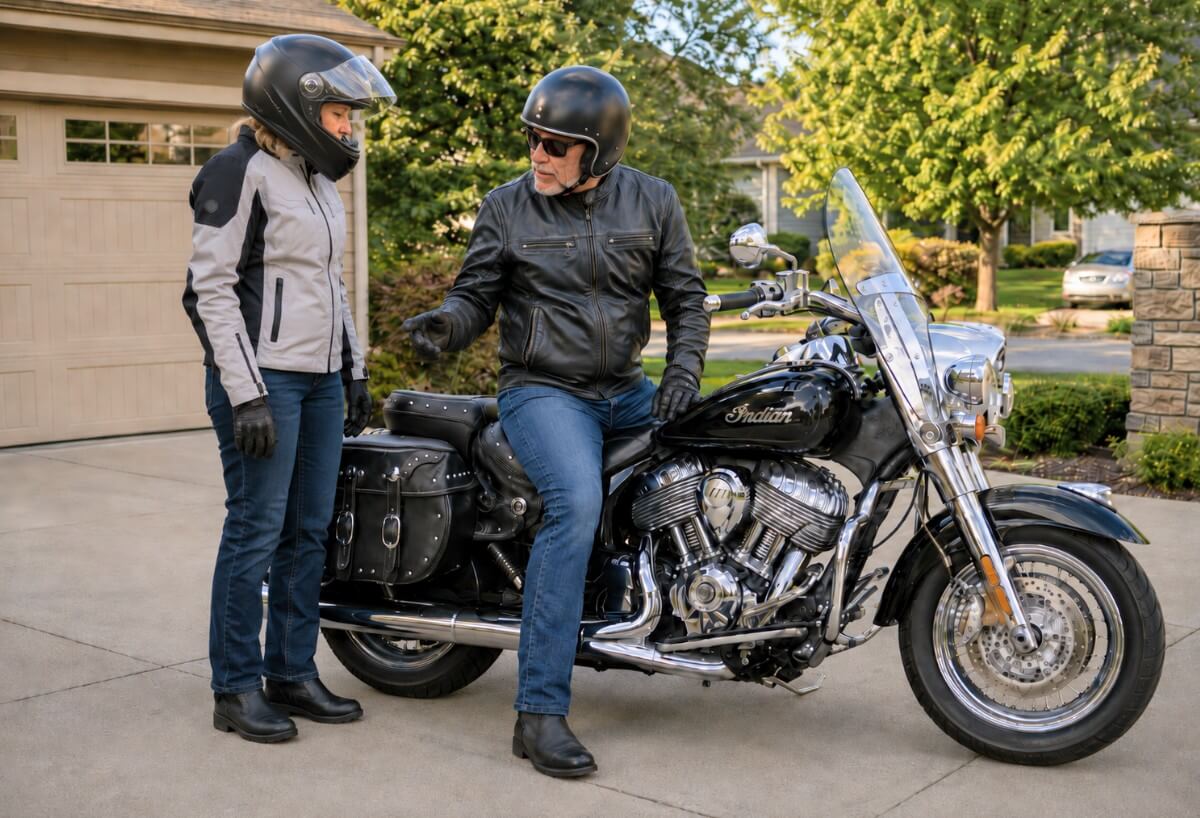
2. Proper motorcycle gear matters
Being on the back doesn’t make your passenger less vulnerable.
Passengers need proper motorcycle gear just as riders do.
That means a suitable motorcycle helmet plus protective clothing appropriate to the ride and conditions.
You might think she already knows this.
But someone who’s never been around motorcycles may genuinely think jeans, sneakers and a cute jacket will be fine.
Or that because you’re “only going for a short ride,” normal clothes will be fine.
Explain what she needs before the day of the ride, if possible.
That gives her time to organise gear rather than standing in your driveway five minutes before departure wearing ballet flats and wondering why you suddenly look alarmed.
And if she has no idea what counts as proper motorcycle gear, start with what motorcycle passengers should wear.
It takes her through the basics without assuming she already knows biker stuff.
3. Where to put your feet
This one takes me straight back to my own first motorcycle ride.
I was nervous.
Very nervous.
I had absolutely no idea what I was doing.
And I hadn’t even noticed that I had my own foot pegs.
What I had noticed were the wheels spinning very quickly and very close to my feet.
My solution?
I stuck my legs straight out.
It felt weird, but seemed the best solution at the time.
Eventually the rider gently introduced me to the concept of passenger foot pegs.
Life immediately improved.
Your passenger shouldn’t have to discover by accident what foot pegs are.
Point them out before you leave.
And explain that her feet stay on them during the ride.
That includes when the motorcycle stops at traffic lights.
New passengers sometimes instinctively put a foot down because that’s what their brain tells them a person on a stationary two-wheeled vehicle should do.
But balancing the motorcycle is the rider’s job.
The passenger should normally keep both feet on her own foot pegs unless there’s a specific reason not to.
4. How to sit and hold on
One of the biggest worries new motorcycle passengers have is beautifully simple:
What stops me falling off?
Cars have doors.
And seat belts.
Motorcycles have… air.
So sitting on a small passenger seat can feel extraordinarily exposed at first.
Explain where your passenger can hold on.
Depending on the motorcycle, she might hold around your waist or hips, use the grab rails, or use another secure hand-hold designed for the bike.
If she’s unsure what will feel safest and most natural, this guide explains how a motorcycle passenger can hold on without hanging on for dear life.
And if the bigger question is body position rather than hand position, it’s also worth looking at how a motorcycle passenger should sit before the ride.
5. What to do in corners
Experienced riders barely think about the sensation of a motorcycle leaning into a corner.
New passengers certainly do.
I remember being told early on that motorcycle passengers were supposed to “lean.”
Unfortunately, I thought that meant I should lurch wildly from side to side every time we went around a corner.
I was trying to help…
I was not helping.
A passenger shouldn’t suddenly launch herself into the corner or fight against the motorcycle by leaning the opposite way.
She needs to stay settled and move naturally with the motorcycle and rider.
For many passengers, looking over the rider’s shoulder towards the direction of the turn can also help.
Most importantly, tell her what to expect before you reach the first decent corner.
A passenger who knows the motorcycle is supposed to lean is much less likely to be startled when it happens.
If corners are one of the things she’s worried about, this guide explains how a motorcycle passenger should lean in corners and what actually helps.
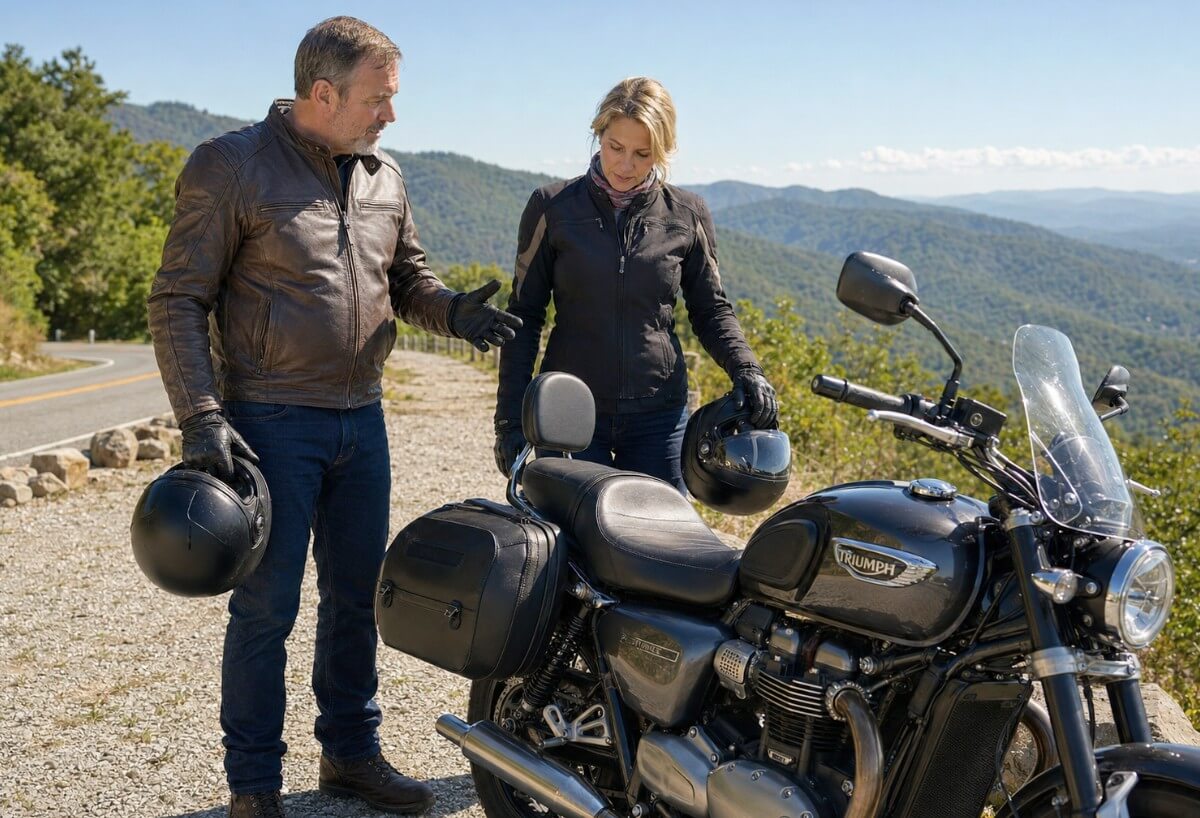
6. Agree on a way to communicate
Talking is kind of difficult at highway speed.
Even with an intercom, wind noise and helmets can complicate things.
So agree on some simple signals before leaving.
At minimum, your passenger should know how to tell you:
I need you to stop.
That could be:
- a tap on the shoulder
- a squeeze
- a particular hand signal, or
- a clear phrase through an intercom.
The important part isn’t which signal you choose.
It’s that you both know what it means.
And if your passenger gives you the agreed stop signal, take it seriously.
She might be frightened.
She might be in pain.
Her helmet might be causing a problem.
She might feel sick.
She might simply need five minutes to reset.
You don’t need to diagnose the problem at 60 mph.
You need to find somewhere safe to pull over.
Good rider-passenger communication starts before the motorcycle moves.
Before you head off, it’s worth talking through what a motorcycle passenger should tell the rider — especially if there’s anything she’s worried about.
7. Don’t scare your passenger for fun
This shouldn’t need saying.
But the fact is, sometimes it does.
Most of us have heard the story.
A guy finally convinces his girlfriend to get on the motorcycle.
Then, within the first few minutes, he accelerates hard, takes the corners aggressively and generally sets out to demonstrate just what a motorcycle can do.
She’s terrified.
He thinks she’ll eventually realise how much fun this is.
She spends the entire ride secretly vowing never to get on the motorcycle again.
And when she gets home (and stops shaking), she also starts researching nice safe Volvos.
If your passenger’s nervous, ride for her confidence, not your ego.
Take it easy.
Let her get used to acceleration, braking, speed and leaning.
You can tell her directly:
“I’m not going to try to scare you. We’ll take it easy, and if you need me to stop, tell me.”
Those few words can completely change the emotional tone of a first ride.
If she’s already nervous, it may help to talk about how to tell the rider you’re scared on a motorcycle before you set off.
And if that fear turns into genuine panic during the ride, I’ve also covered what to do if a motorcycle passenger panics and how to handle it without making things worse.
8. Smooth riding matters
A pillion passenger notices abrupt riding right away.
Hard acceleration throws her backwards.
Sudden braking sends her forwards.
Jerky gear changes move her around on the seat.
And yes, that’s when you get the famous:
CLONK.
Helmet meets helmet.
New passengers often do this anyway.
A helmet feels surprisingly heavy and clumsy when you’re not used to wearing one.
Then add acceleration and braking, and suddenly your passenger feels like a top-heavy bobblehead doll.
She’ll get better at anticipating your movements.
But you can make life considerably easier by being smooth.
Brake progressively.
Accelerate smoothly.
Change gear cleanly.
Give yourself more space.
And remember that your motorcycle now has additional weight to accelerate, slow and manoeuvre.
This is one of the simplest and most useful tips for riding with a passenger on a motorcycle.
Smooth is good.
9. Passenger comfort matters too
There’s a particular kind of rider logic that says:
“I’m comfortable, therefore the motorcycle is comfortable.”
This is not science.
The pillion seat may bear only a passing resemblance to the luxurious throne you’re sitting on.
Your passenger may also be getting:
- more wind
- more helmet buffeting
- more pressure through her hips
- less room to move
- sore knees
- cold hands
- a stiff neck
- numbness, or
- pressure from badly positioned luggage.
And she may not mention that there’s a problem.
That’s particularly true of newer passengers.
They don’t know what counts as normal.
They don’t want to complain.
And they may assume that if you’re happily continuing, they’re supposed to be happy too.
So check.
Not every five minutes.
But when you stop, ask:
“How are you doing?”
And mean it.
If she’s getting sore, cold or generally fed up, there’s usually something you can do about it.
These motorcycle comfort tips for passengers cover the things that actually make a difference.

10. Give your passenger some say in the ride
There’s an old style of motorcycle passenger humour that basically boils down to:
GET ON. SIT DOWN. SHUT UP.
Funny on a T-shirt.
But not such a great foundation for a day out together.
One of the easiest ways to make a passenger feel like part of the experience is to involve her.
Where would she like to go?
Would she rather start with a quiet country road than heavy traffic?
Would she like to stop for coffee after an hour?
Does she want to be out all day, or would a short ride be enough?
If you’re riding a motorcycle with a passenger for the first time, shorter is often better.
The first ride doesn’t need to be a 400-mile endurance event.
A short ride that ends with:
“That was fantastic. Can we do that again?”
is a much bigger success than an exhausting day that proves how far you can travel.
Passengers enjoy motorcycles more when they feel they have some control over what happens.
That doesn’t mean controlling the motorcycle.
It means having a voice in the experience.
11. Silence doesn’t always mean everything’s fine
This one is worth remembering.
Some motorcycle passengers get quieter when they’re frightened or uncomfortable.
They don’t complain.
They don’t tap you on the shoulder.
They don’t create drama.
They just endure.
From the rider’s point of view, everything seems fine.
Meanwhile, the person behind you may be cold, sore, anxious or desperate for a bathroom.
This is why the communication you establish before the ride matters.
You want your passenger to know that speaking up isn’t “ruining the ride.”
If something’s wrong, you want to know.
And the earlier she says something, the easier it usually is to fix.
12. Trust is built one ride at a time
A really good rider-passenger partnership becomes almost effortless.
The passenger learns how the rider brakes.
She knows what acceleration feels like.
Corners stop being terrifying.
She understands the sounds and movements of the motorcycle.
The rider learns her movements too.
You gradually stop feeling like two separate people balancing on a machine and start working together.
But that doesn’t happen because the passenger gets told to “relax.”
It happens because experience gives her reasons to relax.
If every time she says she’s uncomfortable, you listen…
If every time you approach a corner, the bike feels controlled…
If every time she asks you to stop, you stop…
Then she begins to know what to expect from you.
That’s where real passenger confidence comes from.
And over time, that confidence turns into something deeper: trust in the rider.
I’ve written more about how that develops in When a Motorcycle Passenger Starts to Trust the Rider.
After the Ride, Ask One Simple Question
When the helmets come off, ask:
“How was that for you?”
Not:
“Awesome, right?”
Those are different questions.
Give your passenger room to say:
- the speed was fine
- the speed wasn’t fine
- the seat hurt
- she loved the corners
- she hated the corners
- her helmet was noisy
- she wants a longer ride next time
- she needs more stops, or
- she absolutely loved the whole thing.
And tell her what went well from your point of view too.
If you enjoyed having her there, say so.
You don’t need to get all mushy.
No diamond jewellery is required.
Just:
“I really enjoyed riding with you.”
That tells your passenger something surprisingly important.
She wasn’t an inconvenience.
She was part of the day.
A good part.
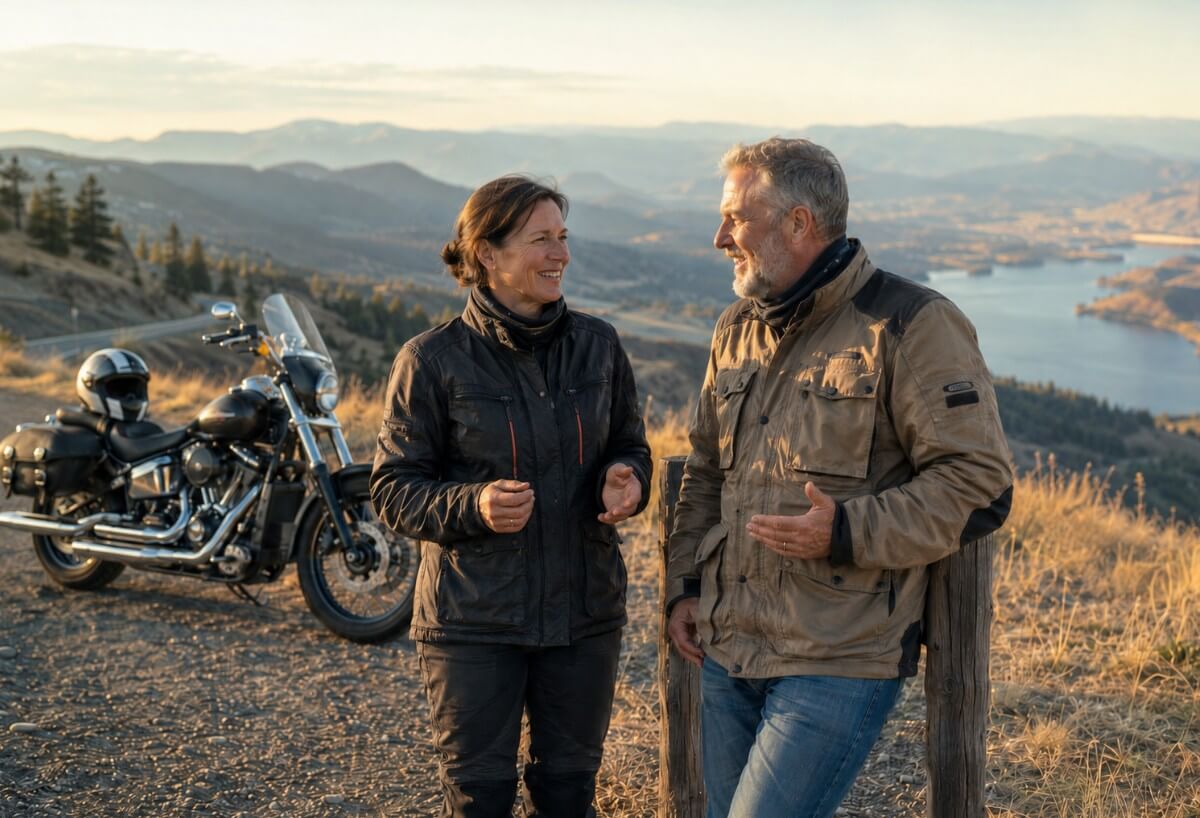
A Good Motorcycle Passenger Isn’t Just Along for the Ride
A passenger does affect the motorcycle.
She needs to understand how to sit, hold on and move with you.
She has responsibilities too.
But riders have an important job at the beginning.
Don’t assume she already knows things you learned years ago.
Show her.
Explain them.
Give her a way to communicate with you.
Listen when she does.
Ride in a way that earns her confidence.
And remember that your passenger isn’t simply another load added to the motorcycle.
She’s the other half of the riding team.
Get that relationship right and riding together can become one of the best parts of owning a motorcycle.
I know that from experience.
Some of the things that terrified or confused me on my earliest rides — where to put my feet, what to do in corners, how to move with the bike — eventually became completely automatic.
That’s what experience does.
But a good rider can make the learning curve a whole lot easier.
Frequently Asked Questions
How do you ride a motorcycle with a passenger?
Prepare the motorcycle first, then explain the basics to your passenger before you leave.
Make sure she knows how to get on and off, where to put her feet, where to hold on, what to do in corners and how to tell you she needs to stop.
Once you’re moving, allow for the extra weight and ride smoothly, with more space for braking and manoeuvring.
Is it hard to ride a motorcycle with a passenger?
It can feel noticeably different at first because the motorcycle is heavier and the passenger can move independently.
Low-speed manoeuvring, braking, acceleration and cornering may all feel different.
Most riders adapt quickly if they ride conservatively and give themselves time to get used to the extra weight.
What should you tell a first-time motorcycle passenger?
At minimum, explain how to get on and off, where to place her feet, how to sit, where to hold on, what to do in corners and how to signal that she needs you to stop.
Tell her what sort of ride you’re planning and reassure her that she can speak up if she feels scared or uncomfortable.
How do you carry a passenger on a motorcycle safely?
Use a motorcycle designed to carry a passenger, with a proper passenger seat and foot pegs.
Stay within the manufacturer’s load limits and follow any recommended tyre-pressure or suspension adjustments.
Make sure both rider and passenger have suitable protective gear, and allow for the bike’s altered handling and braking.
Where should a motorcycle passenger hold on?
A passenger can usually hold the rider around the waist or hips or use suitable passenger grab rails or hand-holds fitted to the motorcycle.
The best option depends on the bike, the riding situation and what gives the passenger a secure, stable position.
What if my motorcycle passenger is scared?
Don’t simply tell her to relax.
Slow things down, communicate clearly and find out what’s frightening her.
A short, gentle ride may build far more confidence than pushing through a long ride.
Agree on a stop signal beforehand so she knows she can ask you to pull over.
How can I make riding more enjoyable for my passenger?
Ride smoothly, involve her in decisions about the destination and length of the ride, stop before she becomes exhausted, check her comfort and listen when she tells you something isn’t working.
A passenger who feels respected and involved is far more likely to enjoy riding with you.
Further Reading
If you want to make riding together easier, safer and more enjoyable, these three guides take some of the most important parts of the rider-passenger relationship a little further.
How Riders Can Help New Motorcycle Passengers Feel Safe
A nervous passenger doesn’t need to be told to relax — she needs a rider who understands what will actually help her build confidence.
What Motorcycle Passengers Should Say Before Riding
Good communication starts before the bike moves. This guide covers the things passengers and riders should talk about before setting off, including comfort, signals and what to do if something doesn’t feel right.
How to Be a Good Motorcycle Passenger: What Actually Matters
This one looks at the other side of the partnership, with practical advice for passengers on how to feel more comfortable, confident and useful on the bike.
Riders and passengers — what’s the one thing you wish someone had explained before your first two-up ride?
For me, it would’ve been the foot pegs and corners. I learned both of those the interesting way.
I’d love to hear what made riding together easier for you.
Great article. I found telling them to look over my shoulder in the direction I’m turning is useful and just enough
Thanks, Sean! Good suggestion!